

Markets End Lower Amid Rising Volatility
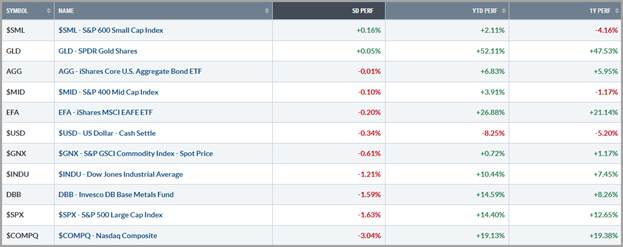
Stocks fell last week as volatility returned, and investors grew more cautious about high market valuations. Big tech earnings came in weaker than expected, and new data hinted at a slowdown in the job market. By the end of the week, the S&P 500 was down by more than -1.5%, while the tech heavy Nasdaq dropped 3%, marking its worst week since April.
Markets started the week steady, helped by talks of possible rate cuts and new AI partnerships among major tech firms. But sentiment quickly shifted after several bank executives warned that tech and AI stocks might be overvalued. Adding to the unease, the ongoing longest U.S. government shutdown in history continued to weigh on confidence, delaying key economic reports and tempering investor enthusiasm.
Despite the pullback, investors continued to see signs of resilience. Some encouraging economic data and hopes for an eventual rate cut seemingly kept losses in check. Still, last week’s moves suggest markets may be entering a more cautious phase as investors balance strong year-to-date gains driven by just a few sectors with rising uncertainty around the economy, corporate earnings, and the lingering impact of the government shutdown.
Rates, Dollar & Commodities
Treasury yields were little changed last week, with the 10-year holding near 4.1% as investors weighed mixed data and uncertainty from the government shutdown. The U.S. dollar slipped slightly, ending two weeks of gains as softer labor data offset early strength from upbeat service-sector numbers.
Commodities mostly traded with a cautious tone. Oil prices fell nearly -2%, gold dipped ever so slightly and copper dropped a sizeable -3% on weak demand signals and trade concerns.
Takeaway
Markets are wrestling with a familiar mix of themes: AI optimism, mixed corporate earnings, and still high yields. The latest bout of volatility reflects growing unease over stretched valuations and the disconnect between AI investment and profitability. Some key technical levels were tested with this past week’s pullback, which was long overdue in the eyes of a good number of Wall Street participants.
Still, corporate balance sheets remain strong, inflation is holding relatively steady, and investor positioning in AI remains robust. For now, this bout of volatility appears to be a healthy correction rather than the start of a broader downturn.
Looking Ahead
All eyes are on Washington this week as the U.S. Senate moves closer to ending the historic government shutdown. Over the weekend, senators voted 60–40 to advance a bipartisan funding measure that would reopen the government through January 30, 2026 and fully fund several key agencies. The bill is expected to face a final Senate vote in the coming days before heading to the House of Representatives for approval. Markets will likely respond favorably if progress continues, as a resolution would allow delayed federal data and operations to resume.
Once the government reopens, analysts expect a wave of backlogged data releases, which could give fresh insight into the economy’s true momentum after weeks of limited information.
Overall, markets are watching for confirmation that the shutdown will end smoothly and for signs that the economy is maintaining a soft-landing trajectory. A successful reopening paired with stable data could help restore confidence heading into mid-November.
Broad Overview
Markets are juggling a mix of encouraging and concerning signals, though overall optimism remains. Investors continue to draw confidence from strong consumer demand, steady corporate spending on artificial intelligence, and expectations that the Federal Reserve will eventually begin lowering interest rates. Inflation has eased significantly since 2022, and the job market is cooling gradually, both suggesting the economy could achieve a “soft landing” rather than slipping into recession.
Still, several warning signs are emerging. Borrowing costs are creeping higher, the strong U.S. dollar threatens to weigh on company profits, and a narrower group of stocks continues to drive most of the market’s gains — conditions that have historically preceded short-term pullbacks. Adding to the caution, investors are starting to question the sustainability of AI “circular financing”, a practice in which big tech firms invest (or commit to investing) in AI projects with other companies and then spend heavily on those same firms’ services. While it boosts revenues on paper, this loop can mask how much real, organic demand for AI products actually exists and begs the question, “Who is really paying the bill for all this expenditure?”
The bond market, often a reliable gauge of economic expectations, continues to signal a slow and steady cooling rather than a sharp downturn. As November unfolds (a month that historically favors equities) market strength may stay concentrated in a few large-cap names before broader participation returns. The key question now is whether investor optimism can endure as valuations stretch higher and the Fed’s tone remains cautious.
We’ll continue to watch these trends closely and keep you updated. If you have any questions about your portfolio or the markets, please contact your CIAS Investment Adviser Representative.
Important Disclosures:
Past performance is not indicative of future results. This material is not financial advice or an offer to sell any product. The statements contained herein are solely based upon the opinions of Edward J. Sabo and the data available at the time of publication of this report, and there is no assurance that any predicted or implied results will actually occur. Information was obtained from third-party sources, which are believed to be reliable, but are not guaranteed as to their accuracy or completeness.
The actual characteristics with respect to any particular client account will vary based on a number of factors including but not limited to: (i) the size of the account; (ii) investment restrictions applicable to the account, if any; and (iii) market exigencies at the time of investment. Capital Investment Advisory Services, LLC (CIAS) reserves the right to modify its current investment strategies and techniques based on changing market dynamics or client needs. The information provided in this report should not be considered a recommendation to purchase or sell any particular security. There is no assurance that any securities discussed herein will remain in an account’s portfolio at the time you receive this report or that securities sold have not been repurchased. The securities discussed may not represent an account’s entire portfolio and in the aggregate may represent only a small percentage of an account’s portfolio holdings. It should not be assumed that any of the securities transactions, holdings or sectors discussed were or will prove to be profitable, or that the investment recommendations or decisions we make in the future will be profitable or will equal the investment performance of the securities discussed herein.
CIAS is a registered investment advisor. More information about the advisor, including its investment strategies and objectives, can be obtained by visitingwww.capital-invest.com. A copy of CIAS’s disclosure statement (Part 2 of Form ADV) is available, without charge, upon request. Our Form ADV contains information regarding our Firm’s business practices and the backgrounds of our key personnel. Please contact us at (919) 831-2370 if you would like to receive this information.
Capital Investment Advisory Services, LLC
100 E. Six Forks Road, Ste. 200; Raleigh, North Carolina 27609
Securities offered through Capital Investment Group, Inc. & Capital Investment Brokerage, Inc.