

A Bumpy Week, But the Market Holds Steady
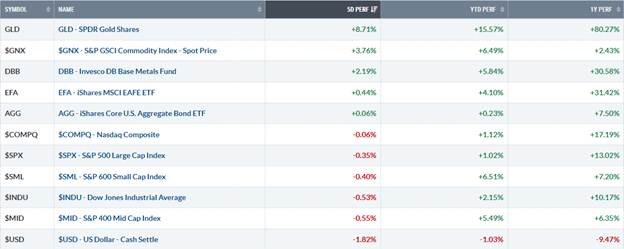
Stocks had a rocky start last week as tariff threats and global headlines rattled investors. But despite the noise, the market once again showed resilience. After several ups and downs, the S&P 500 finished the week down just under -.5% and is still up a little more than 1% for the year.
The week began with a sharp drop after President Trump floated new tariff threats against several European countries, tied to negotiations involving Greenland. That stirred up familiar “trade war” worries and pushed stocks lower at fast pace. At the same time, bond yields jumped overseas, especially in Japan, which added pressure and sparked a short-lived “sell America” move.
By midweek, nerves calmed. The administration softened its tone, and investors refocused on what really matters: the economy… Strong GDP growth and a steady labor market report reminded everyone that business activity remains healthy.
Still, inflation data came in a bit warmer than hoped. That cooled some of the optimism and may have kept the rally from fully taking off. By Friday, stocks mostly moved sideways as investors weighed solid growth against sticky inflation and policy uncertainty.
The big picture? Plenty of headlines… but the market continued to bend, not break.
Rates, Dollar & Commodities
Interest rates bounced around but ultimately stayed in a comfortable range. The 10-year Treasury yield ended near 4.25% while the U.S. dollar slipped a bit as money moved around global markets, but nothing dramatic. Currency moves remained orderly and didn’t create major headwinds.
Commodities, however, were lively. Gold and silver soared to new record highs as investors presumably looked for safety with a hedge against inflation. Energy prices also moved higher with a notable surge in natural gas prices thanks to severe winter weather forecasts. Overall, commodities had a strong week.
Takeaway
If there’s one theme this year so far, it’s this: markets keep dealing with scary headlines—and then move on.
Tariff threats, geopolitical drama, and bond market swings caused some short-term volatility. But underneath all that, the foundation still looks fairly solid. The economy is growing, companies are still earning money, and the job market remains stable.
The main speed bump right now is inflation. Prices aren’t cooling as quickly as the Federal Reserve would like, which could delay interest rate cuts. That doesn’t necessarily mean trouble, it just means progress may be slower than investors hoped.
Bottom line: the fundamentals still matter more than the noise.
This Week – What Matters for Markets
All eyes are on the Federal Reserve this week.
The Fed isn’t expected to cut rates yet, but investors will be listening closely on Wednesday for clues about when cuts might start. If the Fed sounds open to easing later this year, stocks could benefit. If they signal a longer pause, we could see some short-term pressure.
We’ll also get updates on jobless claims, business investment (durable goods), and producer & housing prices. As usual, steady and “nothing scary” data is typically what the market wants to see.
Broad Overview
Right now, the market feels a bit like driving through light fog. Headlines pop up daily and create quick bumps, but the road underneath is still solid.
Economic growth has been steady, the job market has been healthy, and consumers are still spending, which continues to support businesses and corporate earnings. Long-term themes like AI and innovation also remain tailwinds for the market.
That said, it’s not all clear skies. Stock valuations are still on the higher side compared to history, which can limit how fast markets rise from here. We’re also starting to see hints of “late-cycle” behavior. Money appears to be rotating out of some of last year’s big winners and into more defensive or value-oriented areas. That doesn’t signal trouble by itself, but it does suggest investors are becoming a bit more cautious and selective.
In short, volatility may stick around, but as long as the fundamentals stay intact, the bigger picture remains constructive.
Important Disclosures:
Past performance is not indicative of future results. This material is not financial advice or an offer to sell any product. The statements contained herein are solely based upon the opinions of Edward J. Sabo and the data available at the time of publication of this report, and there is no assurance that any predicted or implied results will actually occur. Information was obtained from third-party sources, which are believed to be reliable, but are not guaranteed as to their accuracy or completeness.
The actual characteristics with respect to any particular client account will vary based on a number of factors including but not limited to: (i) the size of the account; (ii) investment restrictions applicable to the account, if any; and (iii) market exigencies at the time of investment. Capital Investment Advisory Services, LLC (CIAS) reserves the right to modify its current investment strategies and techniques based on changing market dynamics or client needs. The information provided in this report should not be considered a recommendation to purchase or sell any particular security. There is no assurance that any securities discussed herein will remain in an account’s portfolio at the time you receive this report or that securities sold have not been repurchased. The securities discussed may not represent an account’s entire portfolio and in the aggregate may represent only a small percentage of an account’s portfolio holdings. It should not be assumed that any of the securities transactions, holdings or sectors discussed were or will prove to be profitable, or that the investment recommendations or decisions we make in the future will be profitable or will equal the investment performance of the securities discussed herein.