

Markets Extend Relief Rally
U.S. equities advanced marginally last week as investors grew cautiously optimistic ahead of upcoming economic data and the next Federal Reserve (Fed) meeting. The S&P 500 rose modestly while the NASDAQ Composite outperformed, helped by renewed demand for growth-oriented and technology names — a sign that some investors may be positioning for a potential bounce rather than a full-blown risk-on surge. While broader risk-on activity remained selective, strength in sectors such as cyclicals, industrials, and parts of tech suggested that leadership may be gradually broadening beyond large caps.
The momentum was supported by a growing consensus in markets that the Fed may deliver a rate cut soon — reinforcing investor confidence in a soft-landing scenario. With bond yields lingering around multi-week highs but with signs of stabilization, sentiment remained tepidly constructive rather than exuberant.
Semiconductors, industrial and materials-linked equities found support amid improved macro assumptions, though energy names lagged amid mixed commodity market dynamics. Overall, market breadth improved just enough that recent volatility looks increasingly like consolidation rather than a resumption of downtrend.
Rates, Dollar & Commodities
Treasury yields firmed slightly on the week, with the 10-year yield moving to around 4.10% and the U.S. Dollar Index weakened modestly, continuing a multi-week slide as markets priced in higher odds of a Fed rate cut.
The softer dollar helped provide some relief to dollar-priced commodities. Industrial metals saw strength, extending a strong monthly gain and broadly reflecting elevated demand expectations. Precious metals also benefited under the current backdrop. Gold traded up slightly, buoyed by the soft dollar and rate-cut expectations, though rising yields capped some upside.
In contrast, Crude Oil remained subdued, showing only a modest uptick over the week amid lackluster demand signals and tepid upward pressure on energy prices
Takeaway
Last week’s modest gains reflect a market cautiously leaning toward optimism. Yields appear to have found a near-term floor, the dollar’s weakening offers relief to commodity-linked sectors, and rate-cut expectations seem to be shaping investor positioning. Metals (particularly copper and gold) continue to draw investor interest, suggesting a tentative shift toward cyclicals and commodity exposure, even as energy remains muted.
While the rally lacks the broad-based enthusiasm of a full-blown reflation trade, the improved tone in rates, currencies and commodity markets helps to enhance the case for a gentle, risk-off-to-risk-on transition. Given how measures of macro stress are easing (or at least not deteriorating) with the new data being released post-government shutdown, recent volatility increasingly looks like consolidation and repositioning vs. a wholesale reversal of the secular trend.
*** Data Below is the last 5 days but includes this morning’s open due to travel delays.
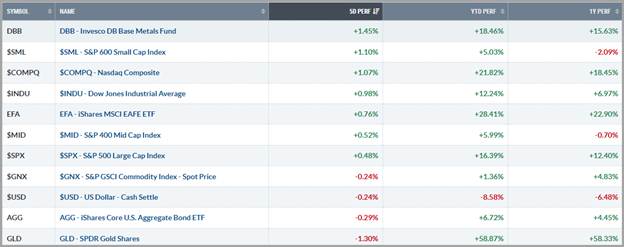
Source: stockcharts.com
This Week- What Matters for Markets
The key economic event this week is the Federal Open Market Committee (FOMC) decision on Wednesday. Markets are broadly expecting a 25 bps rate cut (.25%), but the real story may be what the Fed signals for 2026 via the updated “dot-plot.” If the dots show fewer-than-expected rate cuts, that could weigh on risk assets even if a cut comes this week.
Beyond the rate decision, labor-market data will be under close watch. This week brings the latest reading of weekly Initial Jobless Claims (Thursday) and the upcoming Job Openings and Labor Turnover Survey (JOLTS report, scheduled December 9).
With the Fed meeting, jobless claims, and JOLTS data all converging this week, markets will likely be focused on whether the labor market remains resilient enough to support a soft-landing narrative — but not so tight as to derail the Fed from easing rates further. A dovish Fed decision plus stability in labor data could reinforce rate-cut bets and give another lift to risk assets; anything that hints at labor-market strength beyond what the Fed expects could complicate that view.
Broad Overview
Markets are juggling a mix of encouraging and concerning signals, though overall optimism seemingly remains. Investors continue to draw confidence from strong consumer demand, steady corporate spending on artificial intelligence, and expectations that the Federal Reserve will eventually begin lowering interest rates. Inflation has eased significantly since 2022, and the job market is cooling gradually, both suggesting the economy could achieve a “soft landing” rather than slipping into recession.
Still, several warning signs are emerging. Borrowing costs are creeping higher, the strong U.S. dollar threatens to weigh on company profits, and a narrower group of stocks continues to drive most of the market’s gains — conditions that have historically preceded short-term pullbacks. Adding to the caution, investors are starting to question the sustainability of AI “circular financing”, a practice in which big tech firms invest (or commit to investing) in AI projects with other companies and then spend heavily on those same firms’ services. While it boosts revenues on paper, this loop can mask how much real, organic demand for AI products actually exists and begs the question, “Who is really paying the bill for all this expenditure?”.
The bond market, often a reliable gauge of economic expectations, continues to signal a slow and steady cooling rather than a sharp downturn. As November unfolds (a month that historically favors equities) market strength may stay concentrated in a few large-cap names before broader participation returns. The key question now is whether investor optimism can endure as valuations stretch higher and the Fed’s tone remains cautious.
We’ll continue to watch these trends closely and keep you updated. If you have any questions about your portfolio or the markets, please contact your CIAS Investment Adviser Representative.
Important Disclosures:
Past performance is not indicative of future results. This material is not financial advice or an offer to sell any product. The statements contained herein are solely based upon the opinions of Edward J. Sabo and the data available at the time of publication of this report, and there is no assurance that any predicted or implied results will actually occur. Information was obtained from third-party sources, which are believed to be reliable, but are not guaranteed as to their accuracy or completeness.
The actual characteristics with respect to any particular client account will vary based on a number of factors including but not limited to: (i) the size of the account; (ii) investment restrictions applicable to the account, if any; and (iii) market exigencies at the time of investment. Capital Investment Advisory Services, LLC (CIAS) reserves the right to modify its current investment strategies and techniques based on changing market dynamics or client needs. The information provided in this report should not be considered a recommendation to purchase or sell any particular security. There is no assurance that any securities discussed herein will remain in an account’s portfolio at the time you receive this report or that securities sold have not been repurchased. The securities discussed may not represent an account’s entire portfolio and in the aggregate may represent only a small percentage of an account’s portfolio holdings. It should not be assumed that any of the securities transactions, holdings or sectors discussed were or will prove to be profitable, or that the investment recommendations or decisions we make in the future will be profitable or will equal the investment performance of the securities discussed herein.
CIAS is a registered investment advisor. More information about the advisor, including its investment strategies and objectives, can be obtained by visiting www.capital-invest.com. A copy of CIAS’s disclosure statement (Part 2 of Form ADV) is available, without charge, upon request. Our Form ADV contains information regarding our Firm’s business practices and the backgrounds of our key personnel. Please contact us at (919) 831-2370 if you would like to receive this information.
Capital Investment Advisory Services, LLC
100 E. Six Forks Road, Ste. 200; Raleigh, North Carolina 27609
Securities offered through Capital Investment Group, Inc. & Capital Investment Brokerage, Inc.