

Markets Extend Relief Rally
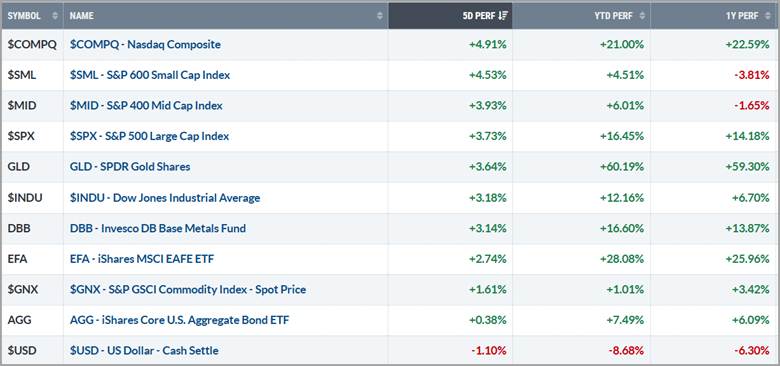
U.S. equities powered higher last week as a strong relief rally lifted markets off their multi-month lows, fueled by softer inflation data and renewed confidence in a soft-landing scenario. Beaten-down tech shares and small caps led the advance as investors seemingly embraced falling yields, a weakening dollar, and broad optimism surrounding 2025 growth prospects. The S&P 500 gained about 3.75% for the week with the NASDAQ and smaller stocks handily outperforming the big index (S&P 500) in the holiday-shortened week.
A combination of cooler September inflation readings, softer retail sales, easing geopolitical tensions, and a chorus of dovish commentary from Federal Reserve officials helped reinforce expectations for a possible December rate cut. Risk appetite broadened meaningfully, with previously lagging areas of the market such as semiconductors, cyclicals, and small caps participating in the move. Tech shares found additional support from AI-related partnerships and upbeat guidance from select hardware and infrastructure providers, offsetting weakness in a few key names.
Market liquidity was thinner than usual heading into the Thanksgiving holiday, which amplified upside moves as short covering and momentum-driven buying persisted throughout the week. The combination of supportive data, bullish sentiment, and dovish Fed expectations helped propel the S&P 500 to its best weekly performance in five months.
Importantly, the rally carried major equity benchmarks firmly above key technical support zones, reinforcing the view that recent volatility represented a digestion phase rather than the start of a broader trend reversal.
Rates, Dollar & Commodities
Treasury yields moved modestly lower (and, bond prices higher), with the 10-year yield slipping 0.06% via the cooler PPI data and firmer soft-landing expectations. Commodities were broadly higher last week as the dollar declined each day of the holiday-shortened stretch and those falling yields provided a favorable backdrop for dollar-sensitive assets.
Industrial metals were the standout performers last week, with benchmark copper surging more than 5.5% to a four-month high and breaking decisively above major technical resistance. Gold also advanced sharply, gaining around 4.75% as falling yields and a weaker dollar provided dual tailwinds.
Energy lagged, with oil rising less than 1% as surplus concerns and progress toward a potential Russia-Ukraine ceasefire briefly reduced the geopolitical premium in oil.
Takeaway
Last week’s gains highlighted how quickly sentiment can improve when inflation cools, yields decline, and economic data remains supportive without overheating. While uncertainties remain, the broader tone across markets strengthened materially, with leadership expanding well beyond the mega-cap complex.
With major indices reclaiming important support levels and macro conditions leaning more market-friendly, recent volatility appears consistent with a consolidation phase inside a longer-term uptrend rather than a shift in underlying economic fundamentals.
Source: stockcharts.com
This Week
This week brings a more current read on the U.S. economy, and the key for markets remains the same: Steady growth without renewed inflation to help keep hopes for a December rate cut intact and support the recent rebound.
Because of lingering government-shutdown delays, we still won’t receive the November jobs report, but markets will get two of the most important monthly indicators: the ISM (Institute for Supply Management) Manufacturing PMI (Purchasing Managers Index) (today) and ISM Services PMI (Wednesday). These are fresh November figures, and the focus remains on both staying above 50, signaling expansion.
Labor data will play a huge role for sentiment, with JOLTS (Job Openings and Labor Turnover Survey)(Tuesday), ADP Employment (Wednesday), and Challenger Layoffs (Thursday) providing a timely look at November hiring trends. After several softer readings, even modest stabilization would be viewed positively and is unlikely to disrupt the Fed’s dovish tone.
Bottom line: As markets digest a fuller picture of the economy, in-line or slightly better-than-expected data would reinforce soft-landing expectations, help anchor rate-cut bets, and support the broader uptrend.
Broad Overview
Markets are juggling a mix of encouraging and concerning signals, though overall optimism seemingly remains. Investors continue to draw confidence from strong consumer demand, steady corporate spending on artificial intelligence, and expectations that the Federal Reserve will eventually begin lowering interest rates. Inflation has eased significantly since 2022, and the job market is cooling gradually, both suggesting the economy could achieve a “soft landing” rather than slipping into recession.
Still, several warning signs are emerging. Borrowing costs are creeping higher, the strong U.S. dollar threatens to weigh on company profits, and a narrower group of stocks continues to drive most of the market’s gains — conditions that have historically preceded short-term pullbacks. Adding to the caution, investors are starting to question the sustainability of AI “circular financing”, a practice in which big tech firms invest (or commit to investing) in AI projects with other companies and then spend heavily on those same firms’ services. While it boosts revenues on paper, this loop can mask how much real, organic demand for AI products actually exists and begs the question, “Who is really paying the bill for all this expenditure?”.
The bond market, often a reliable gauge of economic expectations, continues to signal a slow and steady cooling rather than a sharp downturn. As November unfolds (a month that historically favors equities) market strength may stay concentrated in a few large-cap names before broader participation returns. The key question now is whether investor optimism can endure as valuations stretch higher and the Fed’s tone remains cautious.
We’ll continue to watch these trends closely and keep you updated. If you have any questions about your portfolio or the markets, please contact your CIAS Investment Adviser Representative.
Important Disclosures:
Past performance is not indicative of future results. This material is not financial advice or an offer to sell any product. The statements contained herein are solely based upon the opinions of Edward J. Sabo and the data available at the time of publication of this report, and there is no assurance that any predicted or implied results will actually occur. Information was obtained from third-party sources, which are believed to be reliable, but are not guaranteed as to their accuracy or completeness.
The actual characteristics with respect to any particular client account will vary based on a number of factors including but not limited to: (i) the size of the account; (ii) investment restrictions applicable to the account, if any; and (iii) market exigencies at the time of investment. Capital Investment Advisory Services, LLC (CIAS) reserves the right to modify its current investment strategies and techniques based on changing market dynamics or client needs. The information provided in this report should not be considered a recommendation to purchase or sell any particular security. There is no assurance that any securities discussed herein will remain in an account’s portfolio at the time you receive this report or that securities sold have not been repurchased. The securities discussed may not represent an account’s entire portfolio and in the aggregate may represent only a small percentage of an account’s portfolio holdings. It should not be assumed that any of the securities transactions, holdings or sectors discussed were or will prove to be profitable, or that the investment recommendations or decisions we make in the future will be profitable or will equal the investment performance of the securities discussed herein.
CIAS is a registered investment advisor. More information about the advisor, including its investment strategies and objectives, can be obtained by visiting www.capital-invest.com. A copy of CIAS’s disclosure statement (Part 2 of Form ADV) is available, without charge, upon request. Our Form ADV contains information regarding our Firm’s business practices and the backgrounds of our key personnel. Please contact us at (919) 831-2370 if you would like to receive this information.
Capital Investment Advisory Services, LLC
100 E. Six Forks Road, Ste. 200; Raleigh, North Carolina 27609
Securities offered through Capital Investment Group, Inc. & Capital Investment Brokerage, Inc.